Dear Luther,
It’s been over a year since I saw your exhibition Ambient Photo and I am still thinking so much about it.
Back when I was working at Gallery 44, one of the nicest things for me about being the curator there was the Writer-In-Residence program, and having the opportunity to spend time with your writing. I thought about your words the entire time I was at your exhibition, and kept thinking about how many of the themes you explored in your texts were also being investigated through the materiality of your photographs and the exhibition as a whole.
I have always loved that your residency texts are written in the second person. The intimacy of writing to a reader, to a friend, to a specific someone, is such a welcome change and respite from the detachment of contemporary art discourse. Since then, I have become much more attuned to noticing writing in the second person, especially letter writing, within our ecosystem. Paper Monument published Best! Letters from Asian Americans in the arts, in 2021,[1] and I have enjoyed reading it immensely! I’ve learned so much about the artists that contributed to the publication and was moved by many of the letters. Ken Lum’s contribution was a letter to his late mother. He wrote deeply and insightfully about his mother’s Chineseness, and his regret with his past self for not being able to appreciate this very aspect of her, and so many other things about her when she was still alive, in addition to sharing about his own internalized racism. I often can’t finish reading the letter in its entirety because of how moving I find it. I have loved having this book near me and flipping through to discover how an artist or curator that is part of the broad swath of “Asian Americans” responded to the invitation to share about their racialized and diasporic experiences in letter form. Two of the seven letter writing prompts editors provided contributors with were: “Who do you want to speak to most?” And: “How does it feel to be in your body?”[2] I haven’t read all of the 73 contributions but I did read Josh Kline’s letter addressed “to whom it may concern” that has always stayed with me. He shares about the time a Japanese artist asked him: “do you think you’re Asian?” He then opens up about his experiences growing up in Philadelphia and being in the art world, as someone who is from a Filipino and White-Jewish family.[3] In another, the architect Philip Poon, wrote a letter about gentrification to the fashion designers Echkhaus Latta asking them (well, it’s more like justly interrogating them), about their company and shop’s clichéd presence in NYC’s Chinatown (and LA’s).[4]
About ten years or so ago I read the novel entitled Suicide by the late French writer and artist Édouard Levé.[5] It’s as dark as the title suggests. Written in the second person, the narrator is speaking to a long time friend who lost their life to suicide. There are some beautiful scenes in the book that I’ve always remembered. One is when the narrator writes: “I have only one photograph of you”[6] and goes on to describe an image of his friend blowing out the candles on his birthday cake baked by the author's mother. In another, he describes the time his late friend’s grandfather found his watch in a dry river bed, years after he lost it, to discover that it still works. I tried to read the book again as I was writing this letter to you but couldn’t. Back then, when I originally read it, I think I was very mesmerized with the idea that an entire book could be addressed to a you.
Citizen, and Claudia Rankine’s stirring use of “you” also come up when I think about writing in the second person. Often, the way Rankine’s writing flows and engulfs me, I forget that I am reading something addressed to me, that implicates me. This happens when I read your writing as well. An immersion. I am inside of something and forget that there’s anything else.
Have you ever been in Tofino when the fog lifts? Do you have a favourite letter that you re-read?
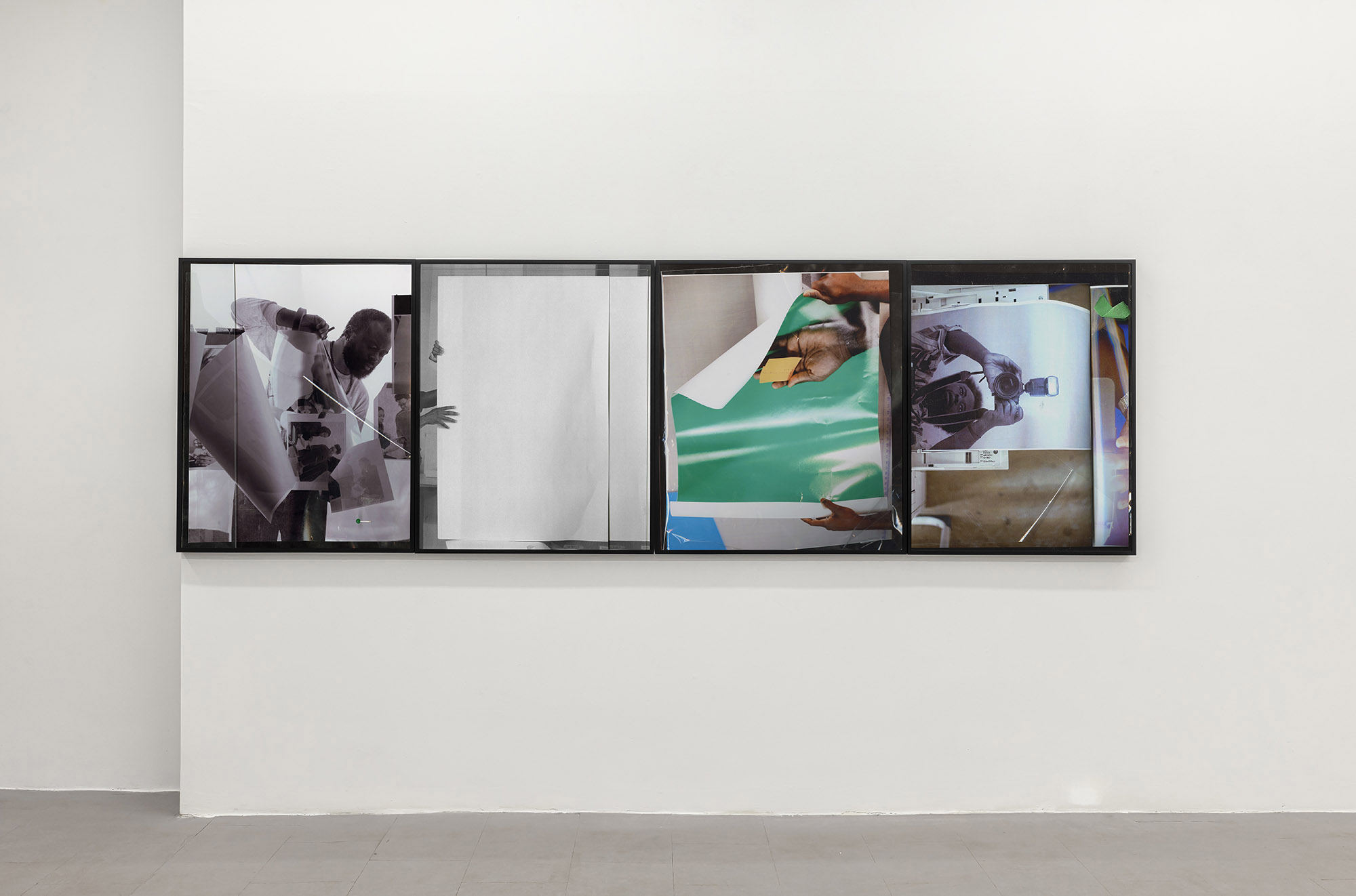
When I was at Ambient Photo I spent a lot of time with the four framed photographs that are sequenced together, in portrait orientation, all the same size and framed in black. I love the way you installed them hung flush against one another and to the edge of the wall. They made me stop and think about your words. Initially this happened because I found myself disoriented: questioning what direction I was looking at and into. I was unsure where the camera was positioned in relation to the black and white photograph of you in your studio. You’re holding photographs, and it looks as though you’re about to tape them to a wall, a transparent wall, perhaps glass? A clear wall with you and the photographs on one side, and the camera on the other. Eventually I realize that I am actually looking at more than one photograph. You’re holding various photographs in your hand, in addition to the ones already adhered to the wall, and the entire image itself seems to be made from two photographs that were scanned together to make one. The edges of the paper give this fact away, as does the resolutely scanned green thumb tack. The fourth photograph in this sequence was perhaps the most disorienting one for me, as I began to navigate what I was looking at and what direction I was looking into. Eventually I grounded myself when I realized that I was looking down at a floor. The camera was positioned from above, capturing a photograph, a black and white image that appeared to have just emerged from a printer (or maybe a photocopier?), of you holding a camera up and slightly away from your face while you appear to look at a digital viewfinder. Vantage points, directions, orientation, multiplicity, materiality—are all played with and foregrounded in this image, and throughout your work.
It was here that I found myself thinking back to your essay on the materiality of glass. In On Glass, part two: brief adventures in the direction of materiality,[7] you align photography with the invisibility of glass. Specifically, large glass wall partitions, ones that are about 12ft high and often found in recreation centres. You noted, they are installed in such a way that further cements the illusion of invisibility. You spend time unpacking the fact that it's not unusual for people to walk right into these walls because they don’t know, can’t see, that they’re there. You write:
You see, glass, like a photograph, first eases us into its literal space. We only see through it rather than at it. It as an actor, an agent, and a substance. What we see instead is the glistening settled pool of water behind it. We are allured. There isn’t enough glare to disturb the view it supplies and so we collide into its discreet, smooth, squeaky clean surface. Before we become aware of its thingness, it’s too late.[8]
These words of yours hone in on the crux of photography, its beauty and biggest self-inflicted hindrance. I suppose, with your exhibition, I was trying to ease myself in, but your practice resists photography’s seamlessness. You ask us to look at it, rather than through, because you foreground the medium’s myriad materialities. Photographs are photographed, printed and reprinted. Black and white prints are photographed and printed in colour. Cacophonously layered upon and next to one another, your printed photographs exist together on the floor, on a wall, on a table, on a cutting board, within a book, in a custom frame. Edges are folded, rolled, torn, taped, pinned. Crinkled packing tape. Flash flares. Swathes of colour. Translucent sleeves. Glare is a protagonist. You revel in the three-dimensionality that a photo can possess. Photographs taken seconds apart are framed identically and hung adjacent to one another. A hand opens in conversation then closes. An arm reaches to select an object, then retreats. Movement through materiality. The motion of slow cinema is shared through the careful selection and placement of stills. Like a perfect light leak, you let viewers into condensed but brief moments in your studio, offering us the chance to imagine the ambience inside your space, peering in as subtle portraits emerge of close friends in the midst of debate and banter.
Is anonymity impossible within a close circle of friends? You muse on anonymity throughout your work. There is a scene in Nothing to be exact,[9] where the “you” you address remembers that they are waiting for fries that they ordered, and upon picking up their snack, walk back out into the streets of a bustling city they are visiting for the first time, and do not know anyone. You write of their experience: “The observer's eye knows nothing of you. And so find the inner lining of this anonymity and dispense of specificity.”[10] Anonymity runs counter to the community togetherness that your photographs foreground.
While it is possible to walk through a city that is completely new to you, and relish in the ability to feel unknown, unnoticed, we both know that anonymity is now impossible. The global state of surveillance capitalism is aware of our every move and thought. And it’s easiest to track those with routine, with consistency, with sameness, is it not? Such data is easier to gather, to follow. But what truths does data collection reveal?
In Ambient Photo, your writing is sporadically placed throughout your photographs. You continue in the second person and write poetically about the weather and the cosmos. I am still working through what words to use in order to share my thoughts and feelings on how you collapse notions of forecasts, vapour, diffusion, patternlessness, with anonymity, community, technology and ambience. I’ve been wondering about the ways in which “patternlessness” is the same as anonymity, if they are similar, and if so - in what ways? And how do I relate these ideas with slow cinema and the materiality of camera technologies? If something is patternless, does that mean it’s haphazard and seemingly disorganized in a way that it needs to be? Is that what you were alluding to when you wrote: “you are speckled across endless space? Immensely long and time consuming observations are needed to begin to understand a phenomenon that is patternless.
At the moment, I feel as though I can only begin to summarize my final thoughts on your work with your words: “…that which remains patternless and thus, eludes measurement, imaging, or a designation into language.
Until soon,
-Heather
[1] Christopher K. Ho, and Daisy Nam, Best! Letters from Asian Americans in the Arts (Brooklyn: Paper Monument, 2021).
[2] Ho and Nam, Best!, 3.
[3] Ibid., 64.
[4] Ibid., 48-52.
[5] Edouard Levé, Suicide (Champaign: Dalkey Archive Press, 2011).
[6] Levé, Suicide, 10.
[7] Luther Konadu, On Glass, part two: brief adventures in the direction of materiality, Gallery 44 Centre for Contemporary Photograph, October 10, 2019, https://www.gallery44.org/residencies/on-glass-part-two-brief-adventures-in-the-direction-of-materiality
[8] Konadu, On Glass.
[9] Luther Konadu, Nothing To Be Exact, Gallery 44 Centre for Contemporary Photograph, July 13, 2019, https://www.gallery44.org/residencies/nothing-to-be-exact
[10] Konadu, Nothing To Be Exact.